From Scope 3 to CBAM: Closing the Carbon Data Gap in International Trade
Charlotte Anne Whitmore
31 Dec 2025
•
7 MIN READ
Introduction
As the European Union’s Carbon Border Adjustment Mechanism (CBAM) advances toward its definitive financial phase in 2026, businesses in global trade face an unprecedented data challenge. While Scope 1 (direct) and Scope 2 (energy-related) emissions are easier to track, Scope 3 emissions across complex supply chains remain a critical blind spot.
This 'carbon data gap' is no longer just an environmental reporting issue—it has become a direct financial, operational, and compliance risk. The quality of your Scope 3 data will directly determine your CBAM costs, compliance status, and competitive position in the EU market.
With Carbalyze, businesses can upload invoices and instantly generate CBAM-aligned reports, turning complex compliance tasks into simple, actionable insights.
Understanding Scope 3 Emissions: The Core of Your CBAM Liability
Scope 3 emissions include all indirect emissions across a company's value chain—upstream and downstream. For importers, these are the primary source of CBAM-reportable emissions, including:
Upstream activities
Raw material extraction, processing, production of purchased components, and inbound transportation
Manufacturing processes
Emissions from sub-suppliers and contract manufacturers
Transportation
Logistics and distribution before products reach EU borders
The Direct CBAM Connection: From Invoice to Financial Impact
Under CBAM's definitive phase, importers must purchase CBAM certificates corresponding to each ton of CO₂e embedded in their goods.
The Critical Choice: Actual Data vs. Default Values
If supplier-specific, verified data is unavailable, EU default emission factors are applied. These defaults are conservative and can inflate carbon liability by 30–50% or more, translating directly into higher certificate costs.
Practical Example : For steel products, actual emissions from an electric arc furnace using renewable energy might be 0.4 tons CO₂e per ton of steel. The EU default value is 1.8 tons CO₂e—450% higher—leading to unnecessary CBAM costs.
Carbalyze in Action: Upload Your Invoice, Get CBAM Report
Instead of manually calculating emissions, Carbalyze enables CBAM invoice automation, allowing businesses to upload invoices directly and instantlygenerate CBAM-compliant reportsThe platform then:
- Identifies CBAM-covered items like steel, cement, aluminum, and fertilizers
- Applies verified emission factors, using supplier data when available
- Calculates CBAM emissions and certificate costs automatically
- Carbalyze generates a clear, auditable CBAM report showing totals, per-item emissions, CBAM status, and financial impact.
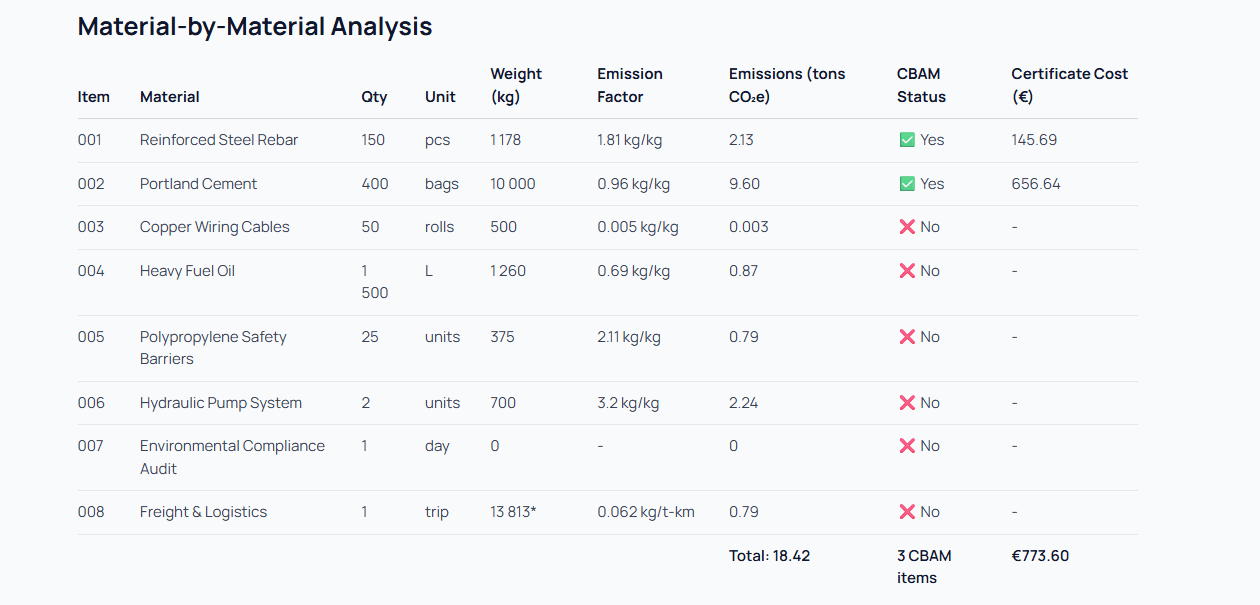
Sample CBAM report from Carbalyze showing per-item emissions, CBAM coverage, and certificate costs, providing clear insight into the financial impact of carbon liabilities.
CBAM Report Breakdown (Example)
- Total Emissions: 18.42 tons CO₂e
- CBAM-Covered Emissions: 11.31 tons CO₂e
- Certificate Cost: €773.60
- Total Cost (Invoice + CBAM): €35,848.60
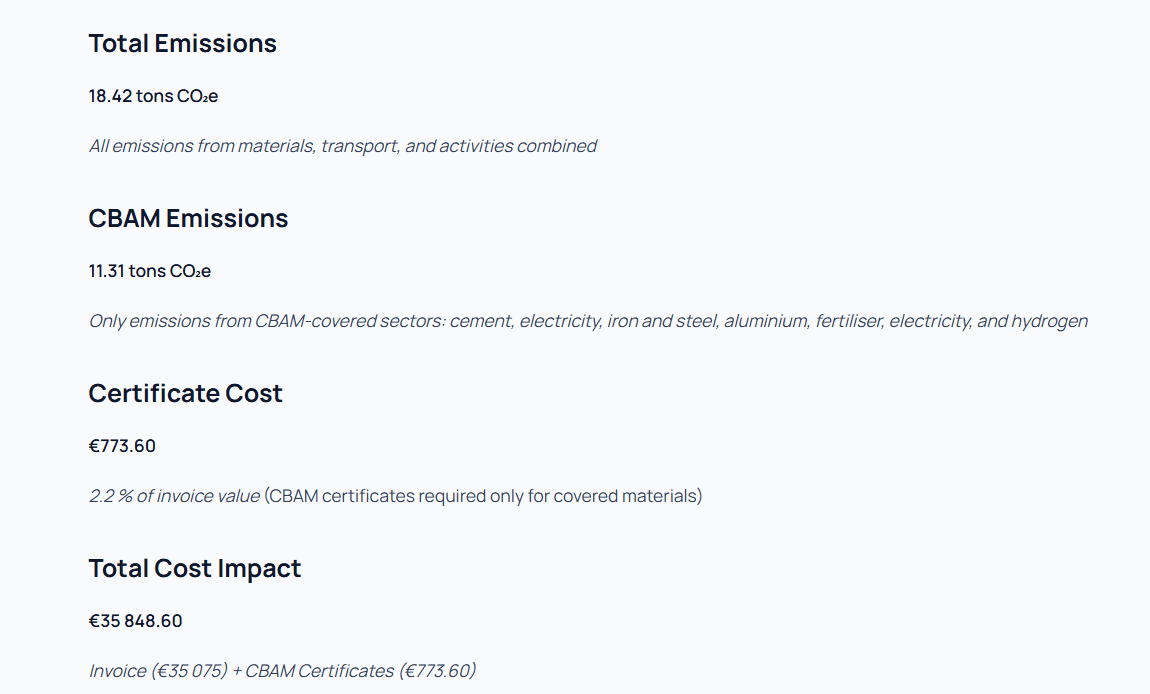
CBAM emissions and costs breakdown, generated using Carbalyze for easy analysis.
Key Insight : Cement contributes the largest share of emissions (52%). Switching to low-carbon alternatives could reduce CBAM liability by around 30%
Closing the Carbon Data Gap
Traditional methods fail under CBAM because of:
Fragmented Supplier Data
Data arrives in inconsistent formats (PDFs, Excel, emails)
Incomplete Information
Missing grades, treatments, or material origins
Manual Spreadsheets
Hard to maintain and error-prone
Carbalyze solves this by automating the workflow, providing a single source of truth, and reducing errors and administrative effort.
Strategic Advantages of Using Carbalyze
Prioritize High-Impact Data Automatically
Carbalyze flags high-emission, CBAM-covered items automatically.
Automate CBAM Calculations
- •Emissions per item are calculated instantly
- •Certificate costs are computed automatically
- •Audit trails document every step
Engage Suppliers Efficiently
Suppliers can input data directly into Carbalyze, and the system validates and tracks responses.
Financial Optimization & Regulatory Readiness
- •Accurate modeling of CBAM costs
- •Scenario analysis to optimize sourcing
- •Preparation for 2026 CBAM financial phase
Benefits Beyond Compliance
- Financial Optimization : Precise CBAM cost modeling allows businesses to forecast liabilities accurately, identify cost-saving opportunities in sourcing low-carbon materials, and avoid unexpected financial exposure. By understanding the carbon impact of each shipment, companies can make informed procurement and pricing decisions.
- Regulatory Readiness : Ensure full alignment with EU CBAM regulations and prepare proactively for the 2026 definitive phase. Staying ahead of compliance deadlines minimizes the risk of fines, penalties, and reporting errors while building a robust audit trail.
- Market Advantage : Transparent, verifiable low-carbon products improve competitiveness in increasingly sustainability-conscious markets. Companies can showcase their carbon-conscious practices to attract eco-focused clients, investors, and partners.
- Operational Efficiency : Automating carbon data management reduces manual effort, minimizes errors, and accelerates reporting cycles. This frees up resources for strategic initiatives rather than administrative tasks.
- Supplier Collaboration : With clear visibility into carbon performance, businesses can work closely with suppliers to improve emissions profiles, encourage sustainable practices, and establish long-term partnerships.
- Strategic Decision-Making : Integrating CBAM data into procurement and operational strategies helps identify high-impact areas for carbon reduction, enabling smarter sourcing, product design, and investment choices.
- Future-Proofing : Companies that master CBAM reporting and carbon footprint management are better positioned to respond to upcoming global carbon regulations and border-adjustment mechanisms, turning compliance into a competitive advantage.
Conclusion
Navigating Scope 3 emissions to meet CBAM requirements has become a critical priority for businesses today. With Carbalyze, businesses can transform a simple invoice upload into a comprehensive, CBAM-aligned report, instantly closing the carbon data gap and gaining clarity on financial exposure.
CBAM is more than a regulatory obligation; it’s an opportunity to streamline carbon reporting, drive supplier collaboration, and strategically manage emissions costs. Companies that act now can turn compliance into a competitive advantage, optimize costs, and demonstrate leadership in carbon-conscious trade.
Don’t wait for the 2026 deadline—start converting your invoices into actionable CBAM insights today with Carbalyze, and take control of both compliance and cost efficiency.
More Insights
Net Weight vs Gross Weight in a BOM: Why Scrap Changes Your PCF
Net weight and gross weight represent different aspects of material use in a BOM, and that difference matters when calculating...
5 Common Factors That Affect Product Carbon Footprint Cost
Product carbon footprint cost can vary based on the system boundary, data quality, product complexity, methodology, and calculation approach. This...
Engineering BOM vs Manufacturing BOM for PCF: What's the Difference and Which Should You Use?
Engineering and manufacturing BOMs provide different views of the same product, and both can contribute to Product Carbon Footprint calculations....
Fueled by intelligent systems to elevate your reading experience.