Still Chasing Suppliers for Emission Data? Caly AI Can Fill the Gaps in Minutes, Not Months
Charlotte Anne Whitmore
19 JAN 2026
•
10 MIN READ
Introduction
If you’re responsible for carbon reporting, sustainability strategy, procurement operations, ESG compliance, or product lifecycle analysis, there’s one uncomfortable truth most teams eventually face:
Supplier emission data is the slowest, most fragmented, and least reliable part of carbon accounting today.
Carbon accounting is no longer a nice to have. It has become a commercial requirement, a regulatory expectation, and increasingly, a customer-driven demand. Yet despite this urgency, many sustainability teams are still operating with workflows that belong to a different decade—manual, reactive, and heavily dependent on external responses they can’t control.
In reality, most teams don’t spend their time calculating emissions. They spend it chasing them.- Chasing suppliers for Scope 3 emissions data, often across multiple follow-ups and timelines.
- Chasing engineers for Bill of Materials (BOM) clarifications.
- Chasing spreadsheets back and forth via email.
- Chasing assumptions hidden inside PDFs, LCA reports, or legacy documents.
- Chasing deadlines that never move, no matter how delayed the data becomes.
After weeks—or sometimes months—of effort, this chasing rarely delivers confidence. Instead, teams are left with:
- Incomplete Scope 3 emissions data, despite significant time investment
- Low confidence in supplier-provided numbers, assumptions, and methodologies
- Carbon reports that are difficult to explain, justify, or defend during audits or customer reviews
- A lingering fear that the Product Carbon Footprint (PCF) won’t stand up to scrutiny
This situation isn’t the result of poor effort or lack of commitment. Sustainability and procurement teams are working harder than ever. And suppliers, in most cases, are not intentionally blocking progress.
This isn’t a people problem. This isn’t a supplier problem. This is a systems problem.
The Hard Truth: Manual Supplier Data Collection Is Broken
The typical process looks like this:
- Request emission data from suppliers.
- Wait weeks for partial or inconsistent responses.
- Manually clean and normalize Excel files.
- Fill missing values using generic industry averages.
- Stitch everything together just to produce a report.
This approach fails because:
- Suppliers don’t prioritize your timelines.
- Data arrives in inconsistent formats and units.
- Primary data is often incomplete or unavailable.
- Manual calculations introduce errors and assumptions.
- Audit readiness is weak, and defensible evidence is thin.
Yet, this broken process is still used to calculate Scope 3 emissions, which often represent 70–90% of a product’s total carbon footprint.
This is not sustainable, not scalable, and not future-proof.
Turn Complex BOMs into Actionable Carbon Insights with Caly AI
Carbon reporting doesn’t have to be slow, frustrating, or error-prone — yet for most companies, it still is. That’s because traditional methods rely on chasing suppliers, cleaning spreadsheets, and making assumptions that weaken audit confidence.
The moment you upload a Bill of Materials (BOM), Caly AI immediately:
Reads and interprets parts, materials, and quantities with zero manual cleanup
Maps every item to verified emission factors, filling gaps where supplier data is missing
Generates audit-ready Product Carbon Footprints — from cradle to gate — in minutes, not months
Highlights material hotspots and reduction opportunities, giving teams actionable insight instead of raw data
No more waiting for supplier responses. No more messy spreadsheets. No more assumptions hidden in PDFs. With Caly AI, carbon intelligence works as fast as your product team thinks.
Unlike traditional tools that stop at reporting, Caly AI turns data into decisions. It doesn’t just show your Scope 3 emissions — it tells you where to act first, which materials drive the footprint, and how to optimize sourcing and production for maximum carbon reduction impact.
What Happens the Moment You Upload a BOM into Carbalyze
The instant you upload your Bill of Materials (BOM) — Excel or CSV — Caly AI takes over.
Yes. It really is.
Step 1: BOM Parsing Without Manual Cleanup
Upload your BOM — Excel or CSV . Caly AI instantly:
- Reads part names (e.g., Deck Wood, Trucks Aluminium, Wheels Polyurethane)
- Understands material types (Mechanical, Plastic, etc.)
- Validates quantities (e.g., 1 kg per part)
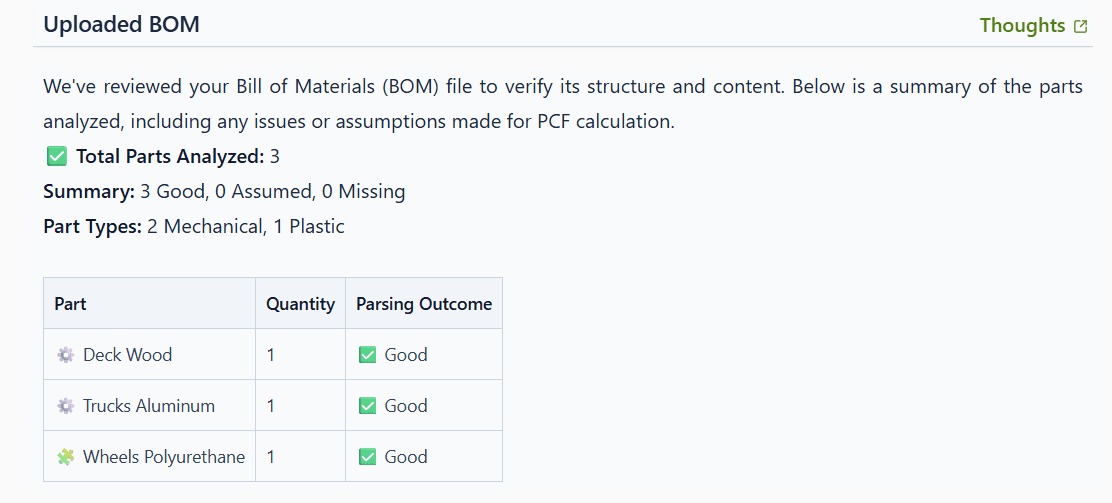
Upload your BOM once. Caly AI validates and understands every part automatically.
Step 2: From BOM to Cradle-to-Gate PCF — Automatically
Once the BOM is parsed, Caly AI moves immediately into carbon calculation mode. It produces a Cradle-to-Gate Product Carbon Footprint aligned with:
- ISO 14067
- IPCC Guidelines
- GHG Protocol principles

ISO-aligned, cradle-to-gate PCF generated automatically — ready for customers and auditors.
It Covers :
- Raw material extraction & processing
- Manufacturing emissions
- Transportation emissions
Step 3: Emission Hotspots — Where Everything Becomes Clear
Instead of a single carbon number, Caly AI highlights:
- Which materials dominate emissions
- How much each part contributes
- Where reduction efforts will have the biggest impact
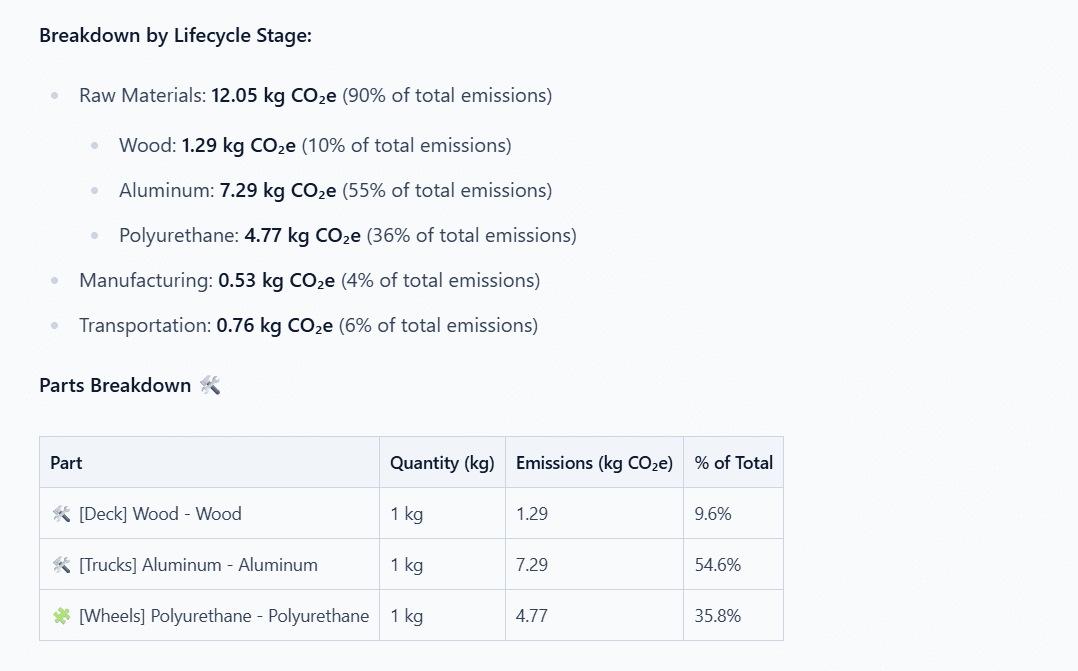
See exactly where emissions come from — not averages, not assumptions.
Step 4: From Insight to Action — What Should You Change First?
Caly AI doesn’t just report numbers — it provides actionable insights:
- Highlights top emission hotspots (e.g., Aluminium production, Polyurethane production)
- Suggests reduction opportunities
- Recommends material substitutions
- Shows sourcing improvement paths

Caly AI doesn’t just show the problem — it tells you where to act first.
How Caly AI Outperforms Traditional Methods
| Aspect | Manual Carbon Accounting | Caly AI by Carbalyze |
|---|---|---|
| Supplier Dependency | Relies heavily on supplier responsiveness; one missing email can stall progress for weeks | Works even when supplier data is incomplete; no delays |
| Scalability | Adding more products or BOMs multiplies effort exponentially | Scales effortlessly across hundreds of products |
| Audit Readiness | Scattered spreadsheets, assumptions, and inconsistent data leave teams exposed | Produces audit-ready, defensible outputs |
| Time & Effort | Months of manual reconciliation and follow-ups; distracts from higher-value work | Delivers results in minutes, not months |
| Impact | Incremental improvements, still error-prone | Category shift in carbon intelligence |
Who Carbalyze Is Built For
Caly AI is purpose-built for organizations that need speed, accuracy, and actionable insight in carbon reporting. It’s designed for teams that can’t afford delays or errors:
- Manufacturers managing complex BOMs and multiple product lines
- Sustainability teams under audit and reporting pressure
- Procurement leaders who need full supplier transparency
- Product teams aiming to design for lower carbon impact
If your team still relies on:
- Manual spreadsheets
- Endless email chains chasing supplier data
- Carbon averages and assumptions
Carbalyze isn’t just helpful. It’s mission-critical.
Why Companies Choose Carbalyze
Forward-thinking organizations adopt Carbalyze because they realize the cost of sticking with old methods:
We were spending months chasing data and still making decisions based on incomplete information
Caly AI eliminates the bottlenecks in carbon accounting:
Instant Access
Stop waiting on suppliers — get verified data automatically.
Full Visibility
Every number is structured, auditable, and backed by reliable emission factors.
Zero Manual Effort
Say goodbye to spreadsheets, reconciliations, and tedious cleanup.
The result? Teams gain real business advantage:
Faster Decisions :
Generate PCFs in minutes, empowering product and sourcing teams immediately.
Audit-Ready Confidence :
Produce outputs that satisfy regulators, customers, and internal stakeholders.
Actionable Insights :
Identify high-impact hotspots, optimize materials, and drive measurable carbon reductions.
Scalable Across Products :
Apply the same system to hundreds of BOMs without extra effort.
Stop Chasing Data. Start Driving Results.
Carbon reporting shouldn’t slow your team down. With Carbalyze, it becomes:
Fast :
Get audit-ready Product Carbon Footprints in days, not months.
Reliable :
Every number is verified, traceable, and defensible.
Actionable :
Identify hotspots, reduce emissions, and make smarter sourcing and design decisions.
Still relying on spreadsheets and supplier emails? That’s wasted time — not effort.
Caly AI fills the gaps. Carbalyze turns data into decisions.
Upload your BOM now — unlock instant carbon insights and take control of your product footprint.
More Insights
Top 10 Sections of a Product Carbon Footprint Report With Checklist
Learn how to structure a Product Carbon Footprint (PCF) report with 10 essential sections covering the executive summary, study goal,...
PCF Allocation Methods: How to Split Factory Energy Across Products
This blog explains how manufacturers can allocate shared factory energy across products to calculate reliable Product Carbon Footprints (PCFs). It...
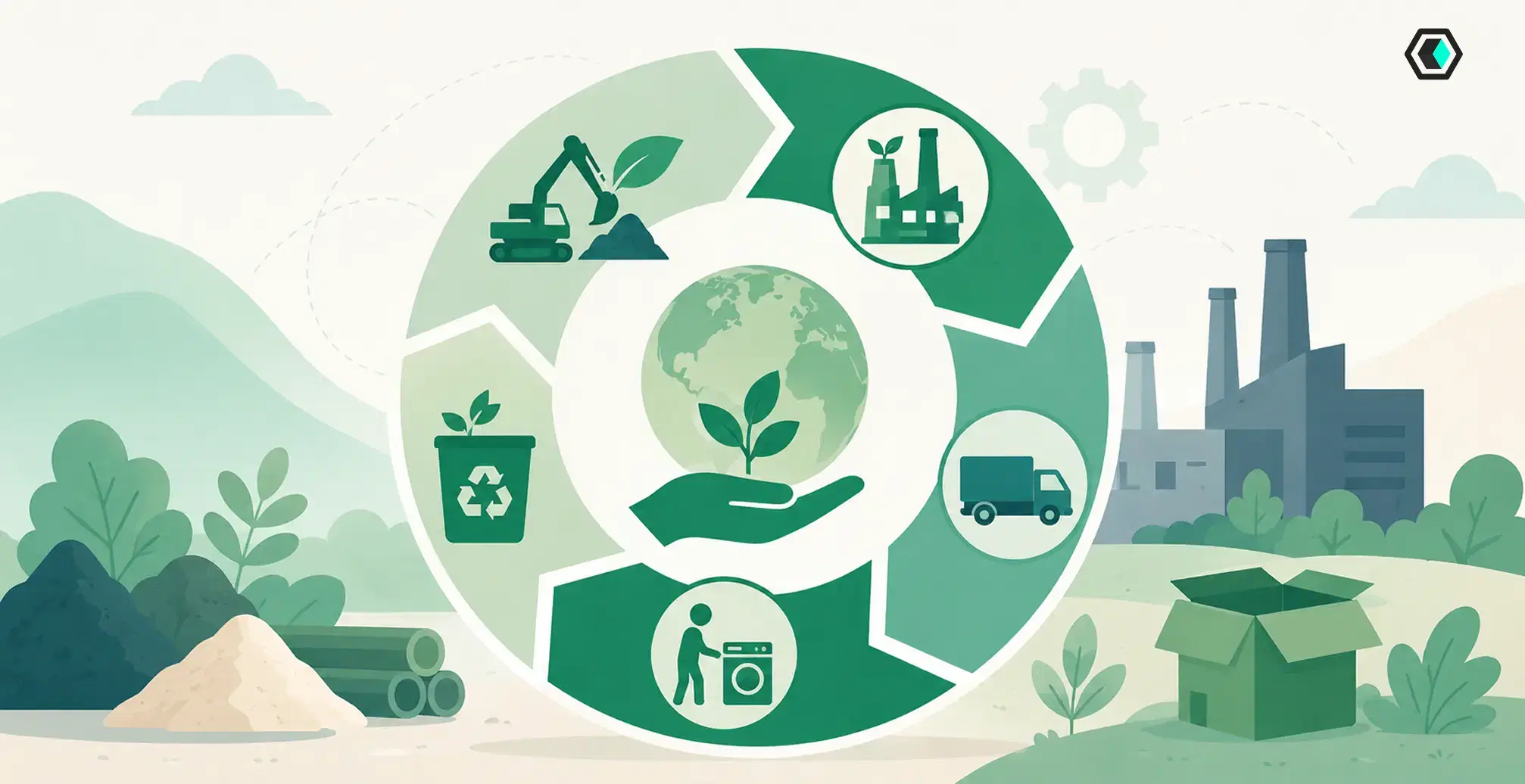
The Product Lifecycle Stages That Drive the Most Carbon Emissions
This blog explains how each product lifecycle stage contributes to a product's carbon footprint, from material acquisition and production to...
Fueled by intelligent systems to elevate your reading experience.